
18 Indoor Recess Games Kids Can Play in the Classroom
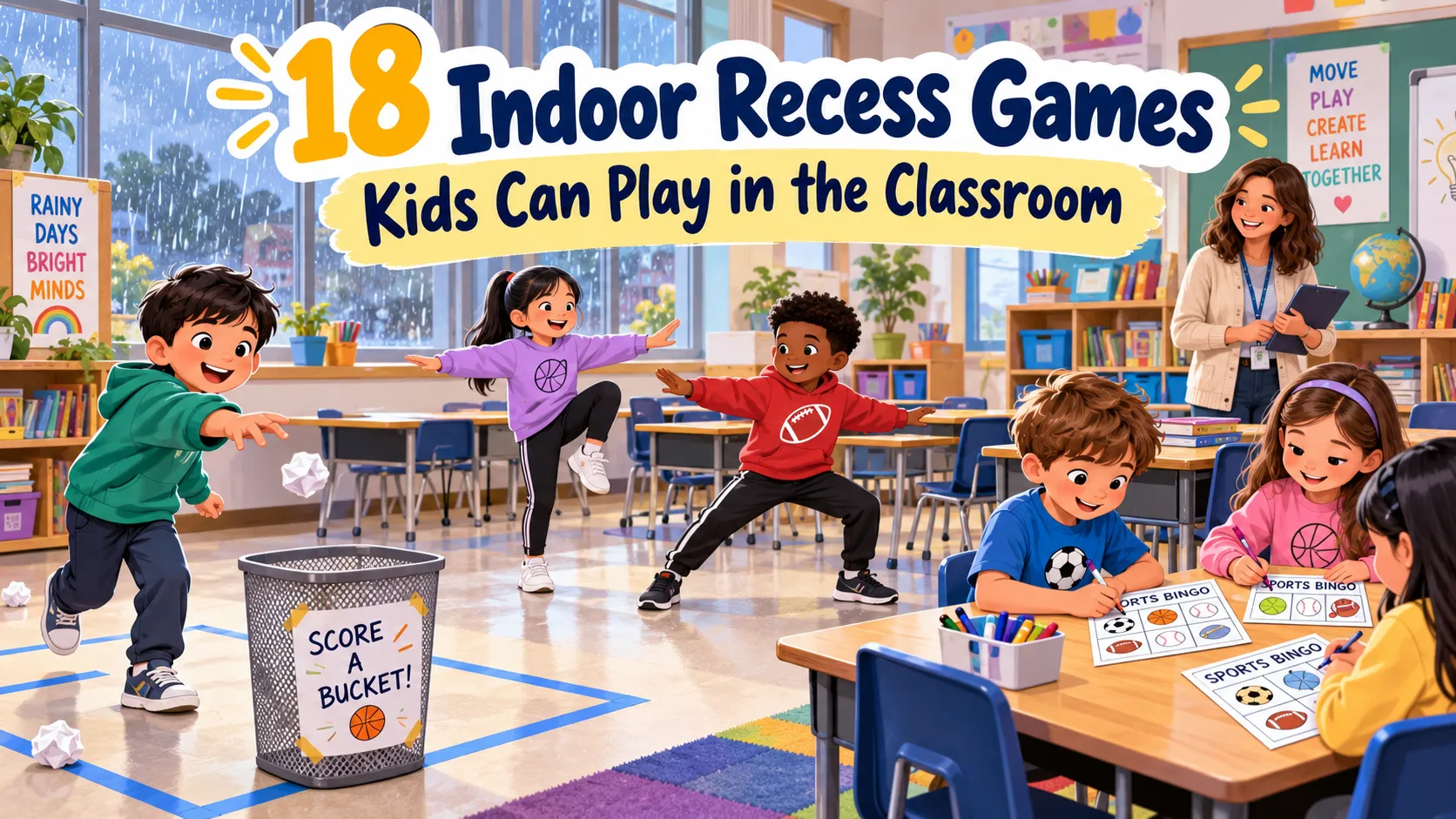
Indoor recess games work best when they match the space you actually have. A classroom with desks can still accommodate pretend sports, tabletop challenges, small-group guessing games, and creative play without turning the room into a gym.
The 18 ideas below are intended for elementary school recess, not a PE lesson. Most use ordinary classroom supplies, and several require nothing at all. Offer students a choice where possible, and use a cleared, supervised area for any game involving a ball or beanbag.
Choose a Game That Fits Your Room
First, check where children can stand, sit, and move without crossing busy walkways. Then consider noise, equipment, and whether everyone can participate without waiting through long turns. In crowded rooms, favor tabletop activities.
| Available space | Try these games | Preparation |
|---|---|---|
| Beside desks | Coach Says, Freeze the Play, Sports Charades | None or a few prompts |
| At tables | Tabletop Soccer, Cup Stacking, Sports Bingo | Paper, cups, or cards |
| Small cleared floor zone | Paper Basketball, Mini Bowling, Beanbag Target Toss | Soft equipment and a marked target |
| Quiet corner | Team Jersey Mystery, Sports Pictionary | Paper and drawing supplies |
Keep targets away from doors and furniture. Without a clear floor area, skip throwing and rolling games.
Movement Games Without Running
These games let children move within their own spots. Demonstrate the boundaries before starting, especially if students will be standing near chairs.
1. Coach Says
Materials: None. Space: Beside desks.
Play a sports version of Simon Says. Call, “Coach says, pretend to dribble a basketball,” or “Coach says, stretch for a catch.” Children follow only commands that begin with “Coach says.” Anyone who follows a different command stays in the game; there is no elimination.
Use three familiar actions for kindergarten students. For older children, combine two moves in one instruction. Keep kicks imaginary and small enough not to reach neighboring players.
2. Freeze the Play
Materials: None; optional music. Space: Personal standing spots.
Name a sport and have students act it out in place. Swimming strokes, gentle jogging arms, and a basketball shooting pose all work. When you call “Freeze the play,” everyone holds still until a new sport is announced.
Let children invent the next action. A seated version uses upper-body poses, so the game doesn’t depend on standing or jumping.
3. Mirror the Athlete
Materials: None. Space: Room for pairs to face each other.
One partner performs slow, controlled movements while the other mirrors them. A pretend tennis serve or goalkeeper stance is enough; no equipment is needed. Switch leaders after several motions. Unexpected changes are the challenge, not speed. Seated pairs can mirror hand and shoulder movements.
4. Sports Movement Sequence
Materials: None. Space: Beside desks or seated.
Start with an imaginary baseball throw. The next player repeats it and adds a second sports motion; each new player performs the growing sequence before adding one more. A group that forgets an action can ask teammates for a reminder.
Begin with a three-action limit for younger children. Older groups may try longer combinations, but restart before remembering the pattern becomes more like a test than recess.
Small-Space Sports Challenges
Use these games only where a clear lane or tabletop is available. Soft, age-appropriate materials and controlled movements matter more than points. In a tight classroom, run one floor station at a time.
5. Paper Basketball
Materials: Crumpled paper and an empty container. Space: Clear target area.
Place a container on the floor and mark a nearby shooting spot. Players toss one soft paper ball at a time while everyone else stands behind the line. Count the group’s successful shots rather than eliminating players after misses.
Offer a larger container for an easier round or an optional farther line for an extra challenge. The target should face away from desks, devices, and other students.
6. Tabletop Soccer
Materials: Cardstock disk, paper goal markers, and a tray or clear table. Space: Tabletop.
Mark a goal at each end of a shallow tray. Two players alternate sliding a flat paper disk toward the opposing goal with one finger. A goal counts when the disk crosses the marked line; if it leaves the playing area, return it to the center.
Use a large, easy-to-handle disk rather than tiny pieces for young students. This is a sliding game, not an excuse to flick objects across the room.
7. Mini Bowling
Materials: Empty plastic cups and a soft ball. Space: Short, clear floor lane.
Arrange a few cups as pins. From a marked spot, each player rolls the ball along the floor, then helps reset the cups for the next turn. Keep the lane separate from foot traffic, and use rolling only—not throwing. Change the cup pattern to make a new challenge. If there isn’t enough room for a dedicated lane, choose Cup Stacking instead.
8. Beanbag Target Toss
Materials: Soft beanbags and flat paper targets. Space: Clear floor zone.
Unlike Paper Basketball, this game rewards landing a beanbag on a specific spot rather than getting it into a container. Lay out targets of different sizes and have students select which one to attempt. Give each child a few turns, then let the next player step forward.
For an alternative to tossing, participants can slide a beanbag along the floor. Change the size or location of the target before making the throw harder.
9. Cup Stacking Challenge
Materials: Lightweight plastic cups. Space: Stable table.
Show a three-cup pyramid and ask players to build it, take it down, and return the cups to a single stack. Once they understand the sequence, offer a new pattern or let partners design one for each other.
A cooperative version has teammates alternate placing cups. Accuracy is the goal; racing isn’t necessary, especially when cups keep falling into nearby workspaces.
Cooperative and Group Games
Group games are easier to manage when everyone has something to do. Divide the class into small teams so one child isn’t performing while everyone else waits.
10. Sports Charades
Materials: Optional slips with sports names. Space: Beside desks.
A player silently acts out a sport while teammates guess. Swimming, baseball, and skating are useful starting points because the movements are easy to recognize without traveling around the room.
Give younger players a choice between two answers. For older students, use an action within a sport, such as a goalkeeper preparing for a shot. Let children perform seated gestures if they prefer.
11. Invent-a-Sport
Materials: Paper and pencil, optional. Space: Tables or standing spots.
Challenge each team to invent a pretend sport with three rules: one movement, one way to score, and one boundary that keeps play within the classroom. For example, players might earn a point by passing an imaginary ball through a sequence of poses.
Teams explain or demonstrate their idea using pantomime, not real throwing or running. Other groups can suggest one adjustment to make the game easier to join. The result is a shared invention.
12. Team Pattern Memory
Materials: Colored cards or cups, plus a cover. Space: Tabletop.
Arrange four or five objects in a pattern and let a team study it. Cover the original, then invite members to rebuild the arrangement from a matching set while discussing what they remember.
Start with a row of colors; try a simple grid once the rules are familiar. Teams can switch roles and create patterns for one another. Everyone can contribute.
13. Mystery Sports Equipment
Materials: None; optional picture cards. Space: Seated groups.
One child chooses a sports object and gives clues without saying its name: what it looks like, where it’s used, or what players do with it. Teammates guess after each clue. Once the object is identified, another person becomes the clue-giver. A tennis racket might be described as something with a handle and strings. Younger children can use drawings; older groups can limit clues to questions answered with yes or no.
Quiet Games and Creative Choices
Quiet recess needn’t become extra classwork. Keep these activities optional and playful, particularly for children who would rather draw, solve a puzzle, or talk with friends.
14. Team Jersey Mystery
Materials: Paper, crayons, and optional jersey outlines. Space: Tabletop.
Each player secretly chooses a sport and designs a jersey with three visual clues—a symbol, color pattern, or piece of equipment. Teammates study the finished design and guess which sport the jersey represents. The artist reveals the answer and explains the clues.
Children can use sports coloring pages as the starting point for a design. There’s no judging of artistic skill, and players may choose to show only the parts they want to share.
15. Sports Pictionary
Materials: Paper and pencils. Space: Tabletop.
Players draw sports-related words while their group guesses. A hoop, a pair of skates, or a baseball glove works better for beginners than an entire game scene. Switch artists each round so everyone gets a chance.
Use picture prompts with early readers. Older children can try more specific ideas such as “relay handoff,” but avoid making spelling part of the game.
16. Scoreboard Detective
Materials: Paper and pencils. Space: Tabletop.
One student draws a simple scoreboard for a fictional match and hides one team’s final score. They share clues such as “The Bears scored six, and the Foxes won by two.” A partner figures out the missing number and explains the answer.
Use easy differences for younger players or several clues for older ones. The fictional scores are a puzzle, not a claim about how a real sport is scored. Partners take turns creating mysteries.
17. Sports Bingo
Materials: Bingo cards and paper markers. Space: Seated groups.
Fill grids with sports or equipment pictures, using different arrangements for different players. Call out an item; students cover the matching square. Agree on a winning pattern before starting, such as a complete row. For a clue-based round, describe “something worn to protect a baseball batter’s head” instead of naming the object. Reusable markers allow the same boards to serve another rainy day.
18. Sports Equipment Match-Up
Materials: Picture cards showing sports and equipment. Space: Tabletop.
Place sports cards on one side of a table and equipment cards on the other. Players take turns making a pair and explaining the connection. A glove might match baseball; a racket might fit more than one sport.
Include a few cards with multiple reasonable matches to spark discussion. Agree in advance that a well-explained answer can count even when it’s different from the expected pair.
Adapt the Games for Different Ages
Adjust the challenge rather than preparing a separate collection of games for every grade. Paper Basketball, for instance, changes considerably when the target becomes larger, closer, or reachable from a seated position.
| Participants | One possible adjustment | What stays the same |
|---|---|---|
| Kindergarten–Grade 2 | Large target close to the player | One controlled attempt at a time |
| Grades 3–5 | Choice of target distances | Toss only toward the marked container |
| Seated players | Place the target at a comfortable, accessible position | Everyone chooses their own challenge |
These are examples, not rigid age standards. Demonstrate rules visually, offer alternate ways to participate, and follow individual support plans and school requirements. A child who can’t or doesn’t want to throw may prefer an equivalent sliding task or another game altogether.
Plan an Indoor Recess Session
Indoor recess is still recess, so children should have room for choice rather than being assigned a tightly scripted lesson. Introduce a couple of familiar options and keep the setup small enough to supervise.
For an illustrative 20-minute period, you could organize the time this way:
- First 2 minutes: Explain available choices and show each game’s boundaries.
- Next 15 minutes: Let students choose an activity and switch when space permits.
- Last 3 minutes: Signal the end, collect supplies, and reset the room.
Those times are an example, not a school-wide rule. Use the actual recess schedule and supervision arrangements at your school.
Set Up Simple Activity Zones
Put quiet games at desks and reserve a small clear area for one rolling or tossing station, if the room safely allows it. Keep entrances and walking routes open. Don’t place a target where a child might cross another game’s lane to retrieve equipment.
If there isn’t room to supervise separate stations, run one group game and leave a seated choice available. Ask students which games they’d like to repeat; a small, familiar selection is easier to manage than introducing something new every day.
Prepare a Small Recess Kit
Keep paper targets, lightweight cups, crayons, reusable bingo cards, and a few soft playing items together. Check supplies for damage and choose pieces appropriate to the age group before play begins.
A labeled box saves setup, but the best plan is flexible: on a crowded day, switch from Mini Bowling to tabletop games without needing to move furniture.
Keep a Few Reliable Games Ready
Pick one movement game, one small-group challenge, and one quiet option that fit your classroom. Teach the rules once, adjust them based on how children participate, and rotate the choices when interest fades. Indoor recess doesn’t need a packed schedule—just enough room for safe, enjoyable play and a genuine break from lessons.