
Fun Field Day Activities for Kids of Different Ages
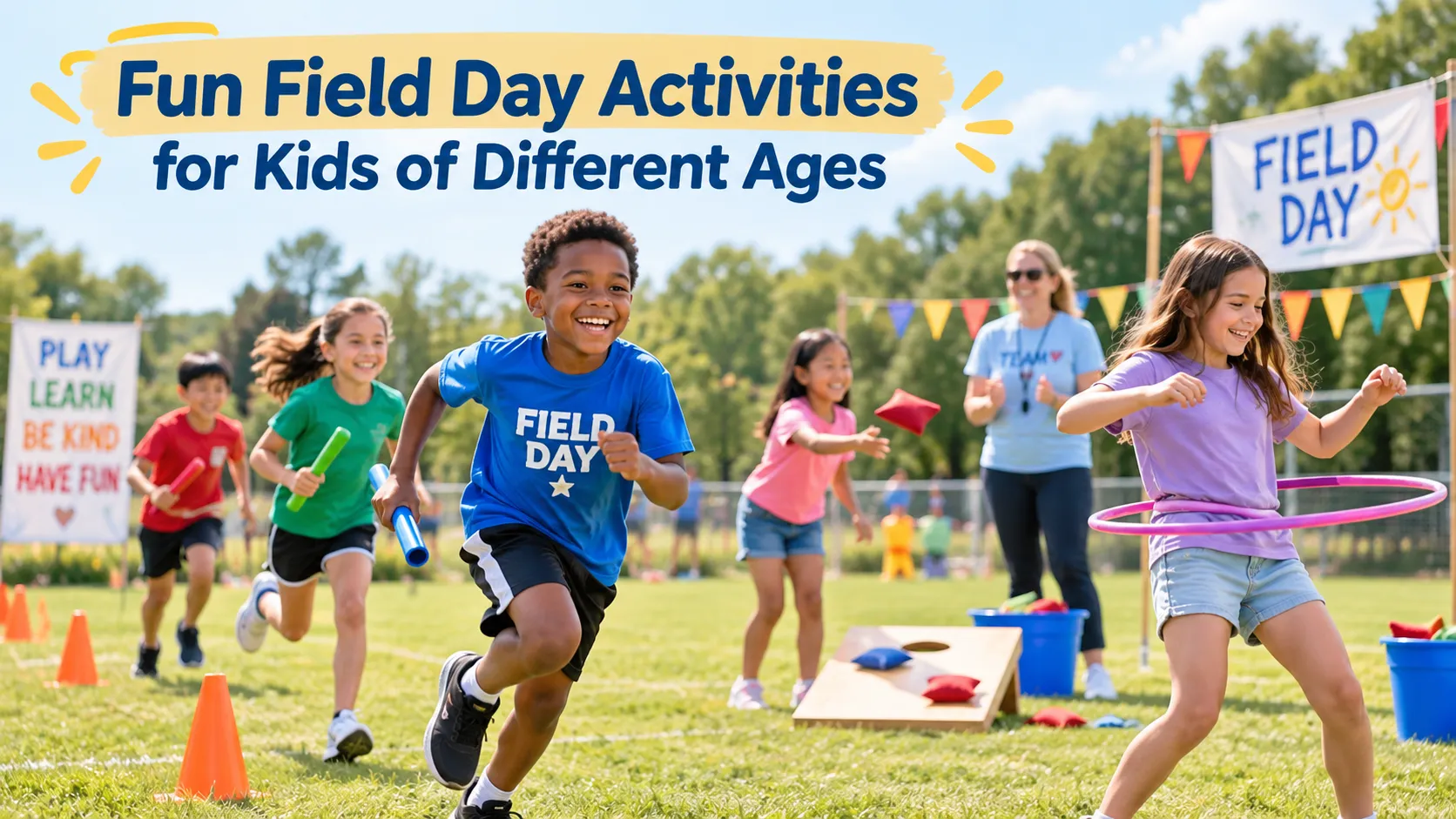
A good field day does not need dozens of complicated games. A better plan mixes active races with accuracy challenges, cooperative stations, water games, and a few slower activities so children use different skills throughout the day.
Start with the space, equipment, age group, and number of adults available. Then build a rotation with enough variety that every station does not reward the same strength. Most of the activities below can be simplified for younger children or made more challenging for older groups without rebuilding the entire event.
Quick Picks for a Balanced Field Day
If you need a workable lineup quickly, combine activities with different energy levels and goals.
| Activity | Best for | Basic equipment | Energy level |
|---|---|---|---|
| Beanbag Target Toss | Accuracy | Beanbags, hoops or buckets | Low |
| Hula Hoop Pass | Cooperation | Hula hoop | Moderate |
| Sack Race | Classic movement | Sacks | High |
| Obstacle Relay | Mixed movement skills | Cones, hoops | High |
| Spoon-and-Ball Relay | Balance and control | Large spoons, soft balls | Moderate |
| Team Ball Transfer | Communication | Soft balls | Moderate |
| Sponge-to-Bucket Relay | Water station | Buckets, sponges | High |
| Ring Toss | Accuracy | Rings, targets | Low |
| Chalk Team Challenge | Creative break | Sidewalk chalk | Low |
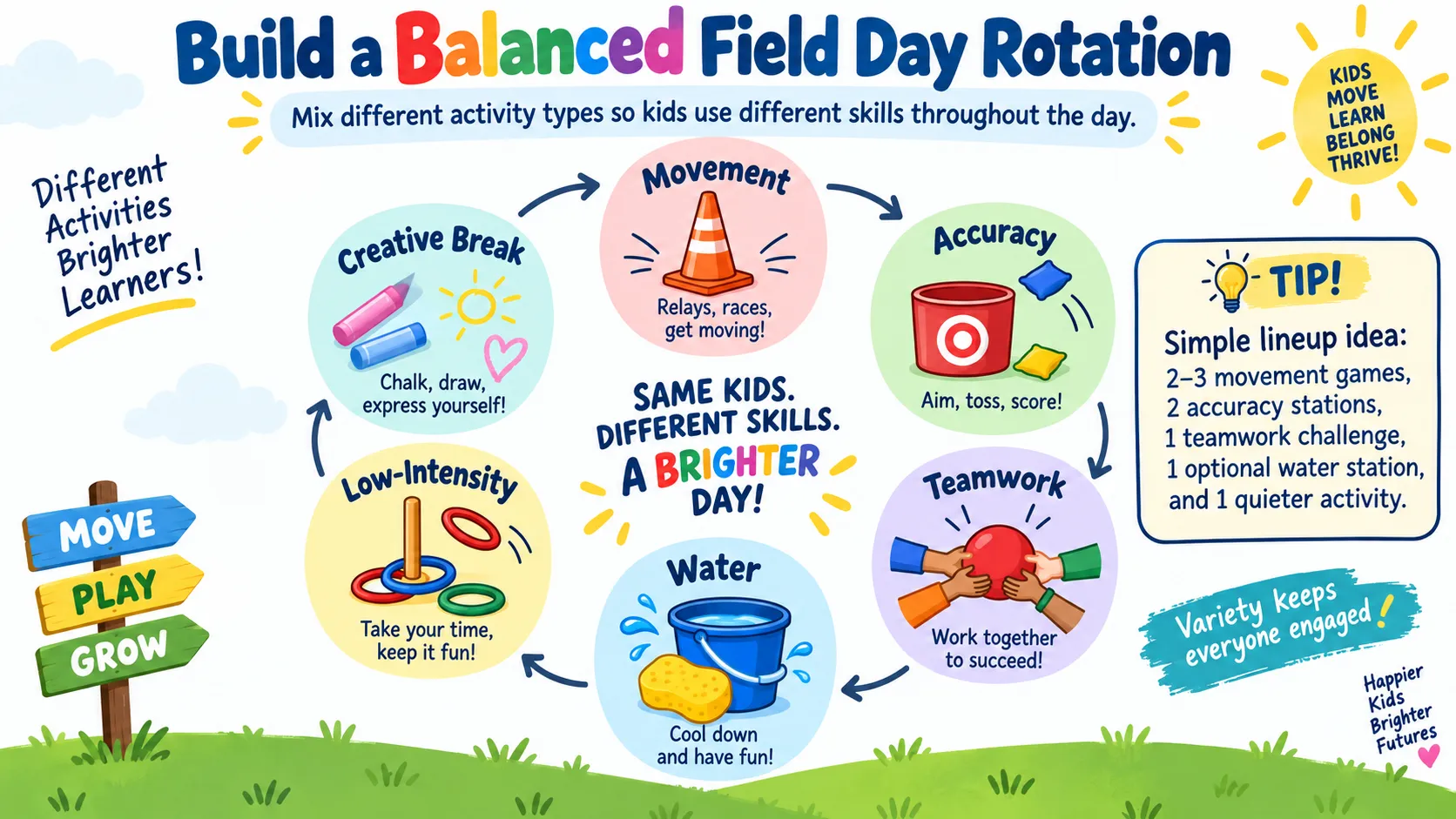
A simple rotation can use two or three movement games, two accuracy stations, one cooperative challenge, one optional water activity, and one lower-intensity station. That creates more variety than filling the schedule with different versions of a race.
Easy Field Day Activities With Minimal Equipment
These stations require little setup and are easy for volunteers to explain. They are especially useful when several grades need to rotate through the same area.
Beanbag Target Toss
Place hoops, buckets, or marked target zones at different distances. Give each child several beanbags and let them aim for the targets.
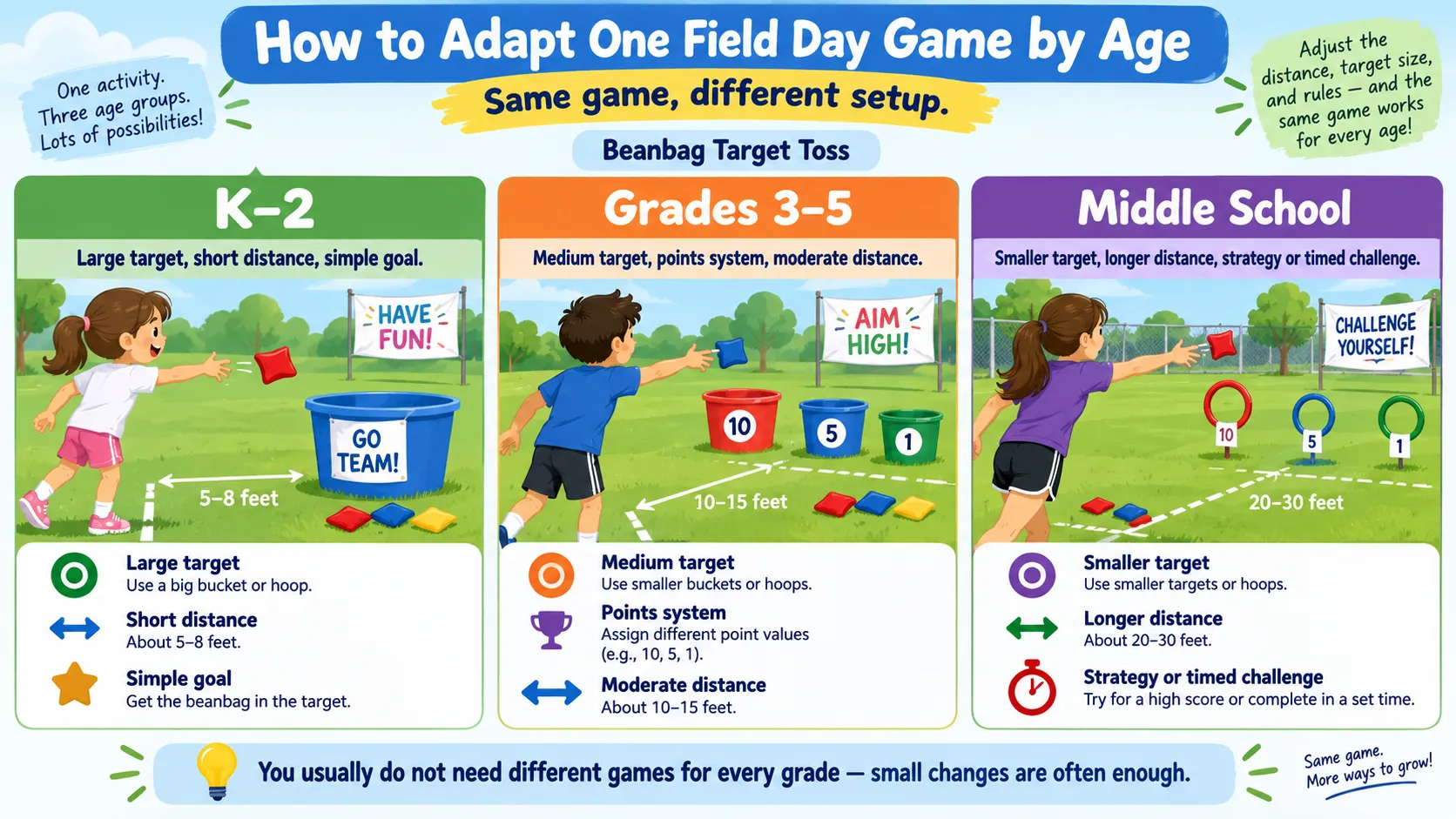
Move the throwing line closer for an easier version or assign different point values to farther targets for older groups. A seated version works as well by adjusting the target height and distance.
Hula Hoop Pass
Have a small team stand in a circle or line while holding hands. Put a hula hoop over one participant’s arm and ask the group to move it from person to person without breaking the chain.
Younger groups can simply complete the challenge. Older children can repeat it and try to improve their own time.
Cone Knockdown
Arrange lightweight cones and mark a throwing or rolling line. Players get a fixed number of attempts to knock down as many cones as they can with soft balls.
Larger targets and shorter distances keep the game accessible to younger participants. Moving the line farther away is enough to increase the difficulty without adding equipment.
Cup Stack Challenge
Place plastic cups on a table and show participants a simple tower or pyramid to copy. Children build the shape and then return the cups to the starting position for the next player.
This station provides a useful change of pace between active games. Older children can add a timer or attempt a more complex pattern.
Chalk Team Challenge
Give each group a section of pavement and a simple prompt. They might draw a team mascot, create a giant sports scene, design a hopscotch course, or add one section to a collaborative picture.
When chalk is impractical, the same area can become a quiet table station. For younger children, sports coloring pages for preschoolers provide a simple alternative that still fits the sports theme.
Relay and Movement Games
Relays bring energy to a field day, but they are more interesting when each station asks for a different movement skill rather than another straight sprint.
Sack Race
Mark short lanes with clear start and finish points. Participants step into appropriately sized sacks and hop toward the finish while holding the top of the sack.
Keep the course short for younger children and leave enough space between lanes to reduce collisions. Older groups can turn it into a relay by passing the sack to the next teammate.
Obstacle Relay
Use cones, hoops, lines, and other low equipment to create a simple route. A participant might weave around cones, step through hoops, circle a marker, and return to the starting point.
For younger groups, keep the path obvious and the movements familiar. Older students can add a balance or accuracy task without making the course unnecessarily hazardous.
Avoid blindfolded running or obstacles that prevent participants from seeing the path ahead.
Spoon-and-Ball Relay
Players carry a lightweight ball on a large spoon from one marker to another. If the ball falls, they stop, replace it, and continue.
A larger ball and short course make the activity easier. A smaller object, additional turns, or a longer path adds difficulty without changing the basic game.
Because control matters as much as speed, this relay gives different children a chance to succeed.
Pool Noodle Ball Relay
Give each team a soft ball and a pool noodle. Players guide the ball along a marked route using the noodle, then return the equipment to the next teammate.
Use wide lanes and emphasize control rather than powerful swings. The noodle should be used to move the ball, not to tag or block other players.
Crab Walk Relay
Mark a short course and let participants crab walk to a turnaround point before returning or tagging the next player.
The distance does not need to be long. Offer a different movement option for anyone who cannot comfortably use the crab-walk position so the station does not depend on one specific physical ability.
Team Challenges That Reward Cooperation
Not every field day station needs a winner based on speed. Cooperative activities add communication and problem-solving to the rotation.
Team Ball Transfer
Teams stand in lines and move a soft ball from one participant to the next. The station leader can choose a simple pattern such as overhead passes, alternating sides, or passing without letting the ball touch the ground.
Begin with one ball. If an older group needs a greater challenge, introduce a second ball or change the direction after everyone understands the pattern.
Giant Tic-Tac-Toe Relay
Create a nine-square grid using chalk, hoops, or floor markers. Give each team three matching markers.
Players take turns moving to the grid and placing a marker. Once all three markers are in play, later participants move one already on the board.
The running component keeps the station active while the grid adds a simple strategy decision.
Parachute Popcorn
Place several lightweight foam or plastic balls on a play parachute. Children hold the edge and work together to keep the balls bouncing without immediately sending all of them off the surface.
Instead of declaring one team the winner, set a cooperative goal such as keeping several balls moving through an entire round. Use the parachute and other equipment according to school and manufacturer instructions.
Water Field Day Activities
Water games can be useful on warm days, but participation should not depend on being willing to get soaked. Keep a dry alternative available for children who prefer one or when school rules, clothing, or weather make water play unsuitable.
Sponge-to-Bucket Relay
Place a bucket of water at one end of a short route and an empty container at the other. Participants soak a sponge, carry it across, squeeze the water into the second bucket, and return.
Teams can try to reach a marked fill line rather than racing to an arbitrary finish. Position the station where spilled water will not create a slippery running route.
Cup Fill Challenge
Set one water container at the start and an empty one at the finish. Players carry water between them using a plastic cup.
Younger groups can walk a short straight path. Older students can navigate around cones or work together to reach a marked level with as little spilling as possible.
Water Target Challenge
Set up lightweight targets and let children use school-approved water-play equipment to knock them down or move them toward a line.
Arrange the station so participants face the targets rather than other groups. Keep the focus on accuracy instead of spraying other children, and choose a surface where water can be managed safely.
Lower-Intensity Stations Add Useful Variety
A full schedule of running games can make field day unnecessarily repetitive. Lower-intensity stations give groups a physical break while still offering a clear challenge.
Ring Toss
Arrange cones or other suitable targets and create more than one throwing line. Participants toss rings and try to land them around the targets.
Short distances and larger targets make the game easier. Older children can choose between several lines with different point values.
Accuracy Challenge
Reuse beanbags or soft balls from another station and arrange several targets with different sizes or distances. Instead of racing, participants try to improve their own accuracy over a short series of throws.
Changing the height and distance also makes the station easy to adapt for seated participation.
Creative Sports Station
A table or sheltered area can serve as a planned recovery station rather than only an emergency rain activity. Children can design a team sign, complete a simple sports puzzle, or color while the next active station resets.
For a low-setup version, easy sports coloring pages work naturally alongside the more physical parts of the day.
Adjust the Games for Different Ages
You rarely need separate activity lists for every grade. Changing the distance, target size, instructions, or scoring is usually enough to reuse the same basic station.
K–2
For younger groups, consider shorter directions, larger targets, simple boundaries, and shorter courses. Demonstrating the activity is often clearer than adding more verbal rules.
Completion can matter more than scoring. A child who moves through an obstacle route or lands a beanbag in a large target has a clear goal without needing to compare results with every classmate.
Grades 3–5
Older elementary groups can add scoring, simple strategy, or longer courses when the group is ready for them.
A target toss can use several point zones. A relay can include an accuracy task at the turnaround point. Cooperative stations can ask teams to improve their previous result instead of simply finishing.
Middle School
Middle school activities often work better when the presentation feels more like a challenge than a game for younger children.
Use longer courses where space permits, add team strategy, introduce more demanding accuracy goals, or offer optional timing. Familiar activities can remain useful when the difficulty and presentation change.
A beanbag station can become a points challenge, while an obstacle course can require teams to decide the order in which members complete different tasks.
Set Up the Day So the Games Actually Work
Even a simple game becomes frustrating when participants spend most of the station waiting or trying to understand the rules. Clear organization matters as much as the activity list.
Give each station an obvious starting area, activity space, and equipment zone. Demonstrate any unusual movement before the round begins, and keep instructions short enough that the next group can start quickly.
Separate active stations so runners, balls, and equipment do not cross into neighboring activities. Assign enough adult supervision for the activity, group size, and school requirements.
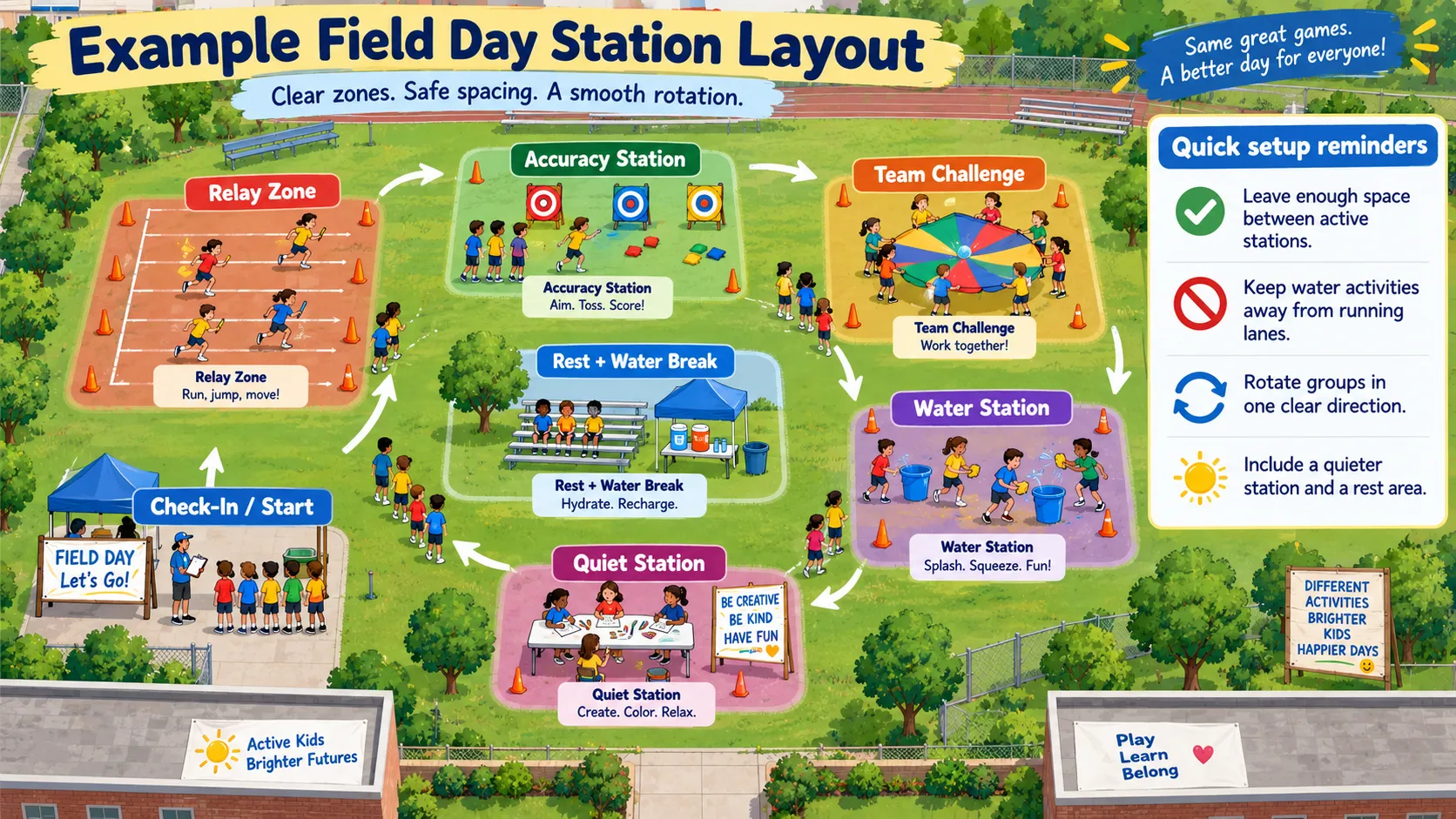
On hot days, plan access to drinking water, shade, and rest breaks. Reduce exertion when conditions call for it rather than expecting the normal schedule to continue unchanged.
Thunderstorms require a separate plan. Outdoor activities should move to an appropriate safe location when thunder is heard or lightning threatens the area. National Weather Service guidance calls for waiting at least 30 minutes after the last thunder before outdoor activity resumes.
Other practical choices can keep rotations moving:
- keep groups small enough to avoid long lines;
- alternate high-energy and lower-energy stations;
- prepare replacement equipment for simple items that may break or disappear;
- identify sheltered or indoor activities before the event;
- give volunteers the rules and reset instructions before students arrive.
A quiet indoor station is useful even when the forecast looks good. It provides somewhere for a group to go if a station needs to close temporarily or weather changes the schedule.
Build Variety Into the Rotation
A strong field day does not need the greatest possible number of games. It needs enough variety that participants are not asked to sprint, throw, or compete in the same way at every stop.
Start with a manageable lineup: two or three movement games, two accuracy activities, one cooperative challenge, one optional water station, and one lower-intensity choice. Then adjust distance, rules, or scoring for each age group instead of rebuilding the entire event.
That approach keeps setup manageable for organizers while giving children several different ways to participate.