
Fun Football Coloring Activities for Game Day
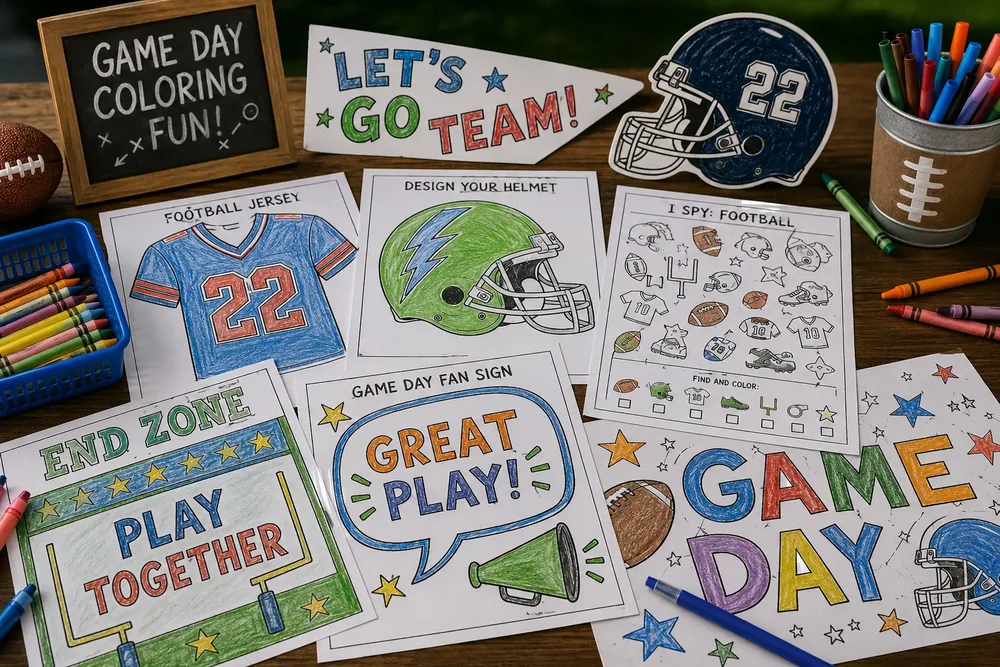
Football coloring activities give children a creative option before kickoff, during quieter parts of the game, at halftime, or after the game. In this article, football means American football rather than soccer.
A small coloring station can work at a family watch party, football-themed birthday, after-school event, or seasonal gathering. Children can design a jersey, decorate a helmet, make a fan sign, or complete one section of a page during each quarter. The best activities are easy to begin, pause, and continue whenever a child is ready.
Set Up a Simple Game Day Coloring Station
A practical coloring station offers enough choice without filling the table with unnecessary materials. Start with two to four page types that support quick coloring, detailed design, and a shared project.
A basic station may include:
- Printed coloring pages
- Crayons or colored pencils
- Washable markers suitable for the children using them
- Short instruction cards
- Separate places for blank and completed pages
- A folder for unfinished work
- Tape or removable adhesive for displaying fan signs
A collection of football coloring pages can provide helmets, jerseys, footballs, goalposts, fields, and game scenes for different activities. Choose a mixture of simple and detailed designs so children can select a page that matches their interests and available time.
Place the station where supplies are easy to reach without blocking the main walking area. Keep drinks away from the pages and give children a clear place to return markers and pencils.
Before making copies for a party or group, check the page’s license or terms of use. A printable being visible or downloadable online does not automatically mean unrestricted copying is allowed.
Football Coloring Activities for Every Part of Game Day
The following activities are designed for different stages of game day. Each one can be completed independently or combined with other pages at the same station.
Choose Game Day Colors
Give children a football, pennant, jersey, or simple border design and ask them to choose two or three colors for the page.
The palette can be completely original rather than based on a professional team. Younger children can work with two colors, while older children may add an accent color and explain what each shade represents.
The completed design can become a place card, folder cover, party decoration, or starting point for an invented team.
Design a Football Jersey
A blank jersey template gives children room to add a number, name, stripes, sleeve details, and patterns.
Children who need a simple starting point can choose from stars, circles, blocks, or zigzags. A more detailed version may include front and back views or separate home and away uniforms.
The jersey can represent a fictional player or a team created for the event. Finished designs can be displayed together as a game day uniform wall.
Create a Custom Helmet
A helmet page works well as a short design challenge. Children can add a stripe, number, initials, animal, shape, or original team symbol.
Encourage simple designs that remain recognizable after coloring. A lightning bolt, mountain, shield, bird, or letter combination can work without copying an official logo.
For a longer activity, children can create two helmets that use the same symbol with different color arrangements.
Decorate an End Zone
An end zone page gives children a defined area for lettering, colors, and repeating patterns. They might add a fictional team name, positive message, geometric border, or football-themed design.
Detailed knowledge of field rules is not necessary. The activity focuses on arranging words, symbols, and colors within the space.
The completed end zone can become part of a larger field poster or be displayed beside jersey and helmet designs.
Play Football Equipment I Spy
Choose a football scene containing several visible objects and prepare a short list of items for children to find.
Possible items include:
- A football
- A helmet
- A jersey
- Cleats
- Goalposts
- Field markings
- A numbered uniform
Children can circle each object or follow a color code. For example, equipment might be colored blue, clothing green, and field details orange.
Older children can count repeated objects or sort them into categories. Review the picture first to make sure every listed item is clearly shown.
Color One Section Each Quarter
An NFL game is divided into four quarters, so a page with four sections can be colored gradually as the game progresses.
Divide one picture into four areas or provide a page with four football objects. Children can use a different color, pattern, or drawing rule for each quarter.
The activity should remain optional and easy to pause. Children do not need to watch every play or complete each section at a specific moment. The quarter structure simply provides a game day rhythm for the page.
Make a Game Day Fan Sign
Provide a large football, pennant, speech bubble, or blank sign template. Children can add a short positive message and decorate the surrounding space.
Possible messages include:
- Let’s Go
- Great Play
- Game Day
- Play Together
- Keep Trying
- Strong Teamwork
Encourage supportive language rather than insults aimed at another team or player. Completed signs can be held during the game or added to the party decorations.
Build a Halftime Group Banner
A halftime banner lets several children contribute to one shared result. Give each participant a letter, football, helmet, pennant, star, or jersey to color.
The pieces can form a phrase such as GAME DAY, PLAY TOGETHER, or the name of an invented team. Another option is to build a banner entirely from separate football-themed designs.
Mixed-age groups can take different roles. Younger children may color large shapes, while older participants work on letters, borders, and placement. The goal is to combine contributions rather than compare artistic skill.
Create a Postgame Memory Page
After the game, children can turn a coloring page into a simple keepsake. They might add the date, names of people at the gathering, colors used, or a favorite part of the day.
The page does not need the exact score or player statistics. A favorite memory might be a celebration, a snack, a funny commercial, or the banner the group created.
Younger children can draw their favorite moment. Older children can add a few sentences before placing the page in a scrapbook or football-season folder.
Choose an Activity by Time and Age
Age and time estimates can help with planning, but they should remain flexible. Interest, drawing confidence, reading ability, and comfort with detailed pictures may be more important than age alone.
| Game day moment | Suggested activity | Approximate time | Best adaptation |
|---|---|---|---|
| Before kickoff | Jersey or helmet design | 15–25 minutes | Prepare several templates |
| During the game | Equipment I Spy or quarter coloring | Flexible | Choose a task that can be paused |
| Halftime | Group banner or fan sign | 10–20 minutes | Divide the project into small pieces |
| After the game | Memory page | 10–15 minutes | Let children finish later |
| Younger children | Football, helmet, or pennant page | 10–15 minutes | Use large outlines and one instruction |
For quick projects or children who prefer less detail, easy sports coloring pages can be adapted with football colors, numbers, simple equipment labels, or short game day messages.
Preschool groups may be more comfortable with sports coloring pages for preschoolers featuring large objects and clear outlines. Give one instruction at a time, such as choosing two colors or adding a single number to a jersey.
A task can be shortened by limiting choices. A jersey design may include only a number and two colors. A longer version can add a matching helmet, team symbol, and fan sign.
Make the Activities Work for a Group
A group coloring station can be straightforward to manage when the pages and supplies are prepared in advance.
Offer several page types rather than requiring every child to use the same design. One participant may prefer a simple football, while another chooses a detailed jersey, helmet, or field scene.
Useful group preparations include:
- Shared containers for crayons and pencils
- Separate piles for simple and detailed pages
- A quiet option for individual work
- A display area for completed fan signs
- A folder for unfinished pages
- Clear table space for assembling the banner
Children should be able to participate without entering a contest. A shared display gives everyone a role without comparing speed, neatness, or artistic ability.
Movement prompts should also remain optional. Some children may prefer to keep coloring, watch the game, or move to a quieter activity.
Use Generic Designs and Check Printing Rights
Generic football templates are usually easier to adapt than pages centered on professional teams, recognizable players, or official logos.
Children can invent names, symbols, colors, and jersey numbers. A simple helmet, football, field, goalpost, pennant, or jersey can support nearly every activity in this article.
Before printing copies for a family event, party, camp, or group, review the source’s license or terms of use. Some printables allow personal or educational copies, while others may have different restrictions.
Fair use depends on the circumstances and is not automatic. For routine group use, the simplest option is to choose printables whose terms clearly permit the intended number and type of copies.
Children can choose any colors they like for a personal activity. For logos and symbols, original designs are easier to use than direct copies of official team branding.
Add a Short Movement Break When It Fits
Coloring is a seated creative activity, but a brief movement break can add variety when the space is suitable.
Children might march in place, reach upward slowly, take gentle side steps, hold a simple balance position, or walk a completed sign to the display area. Avoid throwing activities unless the space is specifically suitable and supervised.
CDC guidance says children ages 3–5 should be active throughout the day. Children and adolescents ages 6–17 should get at least 60 minutes of physical activity each day.
A short game day movement break does not replace active play, organized sports, or other opportunities for physical activity. It is simply a transition between seated activities.
Turn Finished Pages Into Game Day Memories
Completed football pages can become decorations, cards, keepsakes, or parts of a seasonal collection.
Children can:
- Add fan signs to a party display
- Store jerseys and helmets in a football-season folder
- Place the group banner in a playroom
- Turn a football page into a thank-you card
- Add memory pages to a scrapbook
- Use uniform designs in a later storytelling activity
Ask children which pages they want to display, keep, give away, or finish later. Not every project needs to be completed before the gathering ends.
Make Game Day Easy to Join
A flexible station only needs three types of pages: one quick design, one creative project, and one group activity.
Prepare the pages and supplies before kickoff, then let children move between coloring, watching the game, eating, and other activities. They do not need to follow the same schedule or complete every page.
A useful game day activity is easy to understand, simple to pause, and ready whenever a child decides to join.
Frequently Asked Questions
What football coloring activities work best on game day?
Jersey and helmet designs work well before kickoff. Equipment I Spy and quarter coloring can be paused during the game, while fan signs and group banners suit halftime. A memory page can be completed afterward.
How do I set up a football coloring station?
Prepare two to four page types, crayons or colored pencils, simple instructions, and separate places for blank, completed, and unfinished pages. Keep the supplies easy to reach without blocking the main walking area.
What can younger children color during a football game?
Younger children may prefer footballs, helmets, jerseys, and pennants with large outlines. Give one simple instruction, such as choosing two colors, adding a number, or decorating one shape.
Can kids use real team colors and logos?
Children can choose any colors they like for a personal coloring activity. For the design itself, generic templates and original symbols are easier to use than copied official logos. Check the printable’s license before making multiple copies.
What is a good halftime coloring activity?
A group banner works well because each child can color one letter, football, helmet, pennant, or star. The separate pieces can then be combined into one game day message or invented team display.