
Practical Ways to Use Sports Coloring Pages in Class
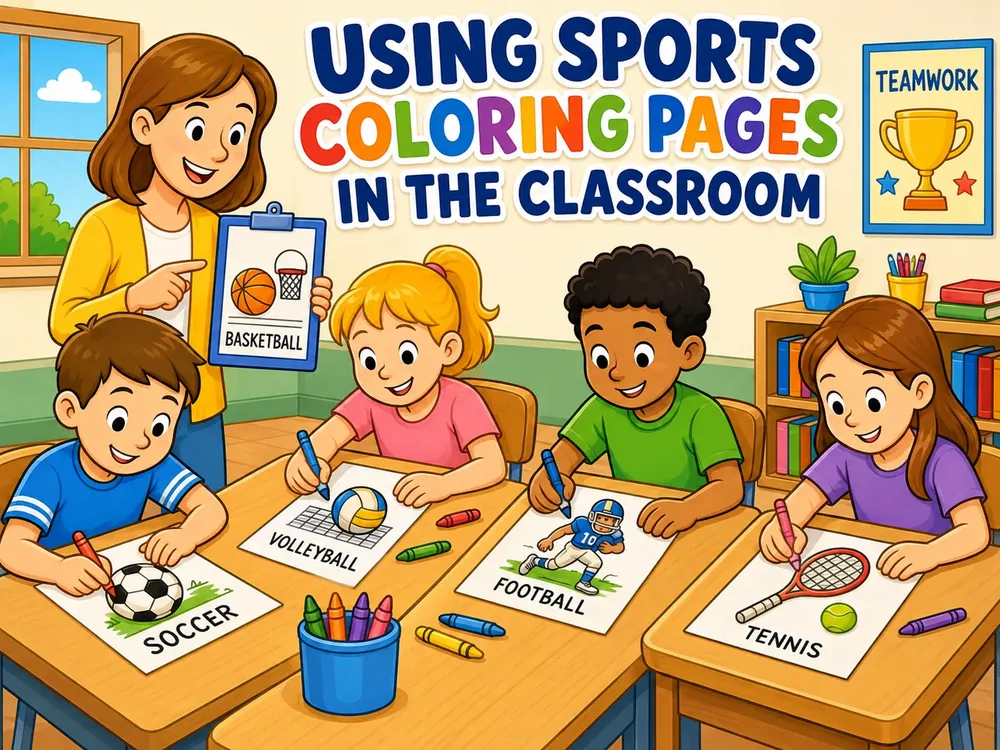
Sports coloring pages work best when they support a specific classroom goal. A printable can introduce vocabulary, support writing, start a discussion about teamwork, or prepare students for movement. Its educational value comes from the task around the picture, not from coloring alone.
Teachers do not need a long lesson plan. One objective, one response prompt, and one follow-up can turn a simple page into a focused activity. Older students can complete comparisons, explanations, designs, or short research tasks.
Start With a Learning Goal
Choose the learning goal before choosing the printable. This keeps the page connected to the lesson and makes it easier to decide what students should do after they finish coloring.
A useful goal should describe something students can identify, explain, compare, calculate, or create. For example, basketball coloring pages could ask younger students to label the ball, hoop, court, and player. Older students could describe the action in the scene or explain how passing supports team play.
A focused classroom activity usually includes these elements:
- One specific learning objective
- A clear instruction connected to the picture
- A written, oral, or practical response
- A quick way to review understanding
Finished pages do not need to look identical. Students may demonstrate understanding through labels, a sentence, a comparison, a discussion response, or a short presentation. Artistic neatness should not determine whether the objective was met.
Practical Ways to Use Sports Coloring Pages
A sports-themed printable can support several subjects without becoming a large project. The key is to add a prompt that gives students a reason to examine the scene and use what they notice.
- Introduce a new sport. Ask students to identify the players, equipment, clothing, and playing area. A set of football coloring pages could be used to introduce terms such as helmet, field, goalpost, and jersey before a short discussion about the game.
- Label equipment and locations. Use a word bank for items such as a racket, helmet, goal, net, court, bat, glove, lane, or field.
- Practice action words. Students can match verbs such as run, jump, throw, catch, kick, pass, balance, or swing to the picture and use one in a sentence.
- Add a reading response. Pair the page with a short passage. Students can write a caption, explain what is happening, or predict the next action.
- Build a math extension. Ask students to count objects, compare scores, sort sports into categories, or collect simple class survey data.
- Discuss sportsmanship. Use a team scene to talk about fairness, encouragement, responsibility, rule-following, and respectful reactions to mistakes.
- Prepare for field day. Introduce activities, equipment, safety expectations, or personal goals before the event.
- Design a team identity. Give students a blank jersey, pennant, or uniform template and ask them to create a name, symbol, and motto tied to a positive team value.
- Create a class display. Combine pages into a mural or gallery showing different sports, equipment, or ways people participate.
- Improve an early-finisher task. Add a meaningful question rather than offering the page as unstructured filler.
Adjust the activity by changing the response. A first grader might copy one equipment word, while a fifth grader could compare two sports or explain why a rule matters.
Match the Activity to the Grade Level
The image and expected response should fit the students who will use them. Younger learners often need large shapes, fewer details, and short oral or written tasks. Older students can work with diagrams, comparisons, explanations, and design choices.
The following table offers a flexible starting point rather than a fixed set of grade-level rules.
| Grade level | Main task | Suitable page | Useful extension |
|---|---|---|---|
| K–2 | Recognize and name | One athlete or object with clear outlines | Say a word, copy a label, or count items |
| Grades 3–5 | Explain and compare | An action scene with several visible details | Write sentences, discuss rules, or answer a sportsmanship prompt |
| Grades 6–8 | Analyze and design | A playing-area diagram, uniform template, or game situation | Research a term, explain a strategy, or defend a design choice |
Reading level, motor needs, background knowledge, and confidence may matter more than the listed grade. Teachers can offer a word bank, sentence frame, oral response, or simplified page when needed.
For preschool and early elementary groups, sports coloring pages for preschoolers can provide large, recognizable objects and less visual detail. Teachers who need quick activities for a wider age range can also choose easy sports coloring pages and adjust the accompanying question rather than changing the picture.
For older learners, avoid making coloring the entire assignment. Add a question that requires interpretation, such as comparing equipment, explaining a rule, or redesigning a uniform for a particular environment.
Turn One Page Into a Mini-Lesson
One well-chosen page can support observation, vocabulary, independent work, discussion, and movement. Keep the sequence simple enough for the available class time.
- Choose one objective. Decide whether students will identify, describe, compare, explain, calculate, or create.
- Select an accurate page. Check that the equipment, playing area, and body positions are understandable and appropriate for the age group.
- Introduce a manageable set of terms. Choose only the words students need for the activity.
- Give the full instruction before students begin. Explain both the coloring task and the required response.
- Ask students to use the image. They can label, write, compare, sort, calculate, or explain.
- Review the response. Use partner sharing, a quick class discussion, or a brief check of the completed work.
- Add movement when it fits. Connect the page to a safe demonstration, activity station, movement break, or later PE lesson.
For example, soccer coloring pages might show a ball, goal, player, and field markings. Students can label three items and write one sentence using kick or pass. The class can then demonstrate a slow kicking motion without a ball, provided the movement suits the space, student needs, and school safety rules.
Three Classroom Examples
These examples show how a printable can become a complete activity. Adapt them to other sports by changing the vocabulary, prompt, and follow-up.
Basketball Vocabulary and Action Words
Choose a page that clearly shows a player, ball, hoop, and part of the court. Introduce a short word bank with terms such as ball, hoop, court, dribble, pass, and shoot.
Students color the scene and label the visible objects or locations. They then choose one action word and write a sentence describing the picture. Younger students can complete a frame such as “The player can ___ the ball.”
A brief movement connection can follow. Students may stand in place and slowly demonstrate a dribbling, passing, or shooting motion without equipment while maintaining safe spacing.
Design a Jersey Around Sportsmanship
Provide a blank jersey or uniform outline without professional branding. Ask students to invent a team name and choose a symbol that represents respect, fairness, persistence, encouragement, or responsibility.
Students add a short motto or one team rule. After coloring, they explain how one design choice represents the selected value. A student might say that linked circles represent teamwork because every player has a role.
The finished designs can be grouped on a classroom display under headings such as Respect, Teamwork, and Effort. This keeps the focus on the ideas rather than ranking artistic skill.
Compare Sports Before Field Day
Choose pages that show activities such as running, jumping, throwing, or relay events. Ask students to identify the equipment, space, and type of participation each activity requires.
Students can sort the activities into useful categories. They might compare individual and team events, activities with and without equipment, or events that emphasize speed, distance, balance, or coordination.
Each student then selects one activity and explains why it seems interesting or what they would like to learn. The response should focus on curiosity and participation, not on predicting athletic performance.
Keep the Activity Inclusive and Manageable
Students may need different tools, page designs, or response options. Make the learning task accessible without requiring everyone to complete it in the same way.
Practical adjustments include:
- Choose pages with large, clear outlines
- Offer more than one level of visual detail
- Provide crayons, colored pencils, or other suitable tools
- Allow an oral response when a long written answer is not appropriate
- Let students color selected areas instead of every detail
- Avoid using color as the only way to show a correct answer
- Provide a word bank, sentence frame, or labeled example
- Prepare materials and a collection area before the lesson
- Evaluate the academic response rather than artistic neatness
Review each image before printing it. Check whether the equipment, clothing, body positions, and playing area are represented clearly. Generic athlete, equipment, and uniform templates are often easier to adapt than pages built around professional branding or celebrity images.
Before making a class set, check the source’s license or terms to confirm that classroom copying is allowed. Educational use can qualify as fair use in some circumstances, but it is not automatic. Pages that expressly allow classroom copies are the simplest option for routine use.
Use Coloring Alongside Movement
A coloring page can reinforce terminology, rules, observation, and discussion, but it does not replace physical education, recess, or movement instruction. SHAPE America’s National Physical Education Standards describe what students should know and be able to do through an effective physical education program.
The CDC recommends at least 60 minutes of physical activity each day for children and adolescents ages 6–17. A paper-based activity does not provide that movement, although it can prepare students for active participation.
For example, students might identify parts of a baseball field before going outside or review safe spacing before a throwing activity. A short movement extension can reinforce the lesson, but classroom physical activity should be offered in addition to PE and recess rather than replacing them.
The distinction is simple. The coloring page supports understanding. Movement practice gives students the opportunity to apply skills physically.
Make Every Page Serve a Purpose
Before printing a sports coloring page, decide what students should notice, what they should explain or create, and what will happen after the page is finished.
One learning goal, one clear prompt, and one follow-up can give the printable a defined role. Choose a page that fits the students, connect it to the subject, and evaluate the response rather than the coloring itself.
Frequently Asked Questions
How can teachers use sports coloring pages in the classroom?
Teachers can pair sports coloring pages with labeling, vocabulary, writing, counting, comparison, sportsmanship discussions, or short movement activities. The page works best when students have one clear task to complete before or after coloring.
How can a sports coloring page become an educational activity?
Start with a specific learning goal. Students might identify equipment, use sports-related action words, explain what is happening in a scene, compare two activities, or write about teamwork. The learning task should be more important than the artistic result.
Which sports coloring activities work for different grade levels?
Students in K–2 can use simple pages for naming, labeling, and counting. Children in Grades 3–5 can write sentences, compare sports, or discuss rules and sportsmanship. Older students can analyze game situations, design uniforms, or complete short research and writing tasks.
Can sports coloring pages be used in physical education?
They can support lessons about equipment, terminology, rules, and safe participation, but they should not replace physical education, recess, or movement practice. A coloring task may be followed by a safe demonstration, movement break, or active lesson.
Can teachers print any sports coloring page for the whole class?
Not always. Before making multiple copies, check the website’s license or terms of use to confirm that classroom printing is allowed. A page being available online does not automatically mean it can be reproduced without restrictions.