
16 Easy Sports Activities for Preschoolers
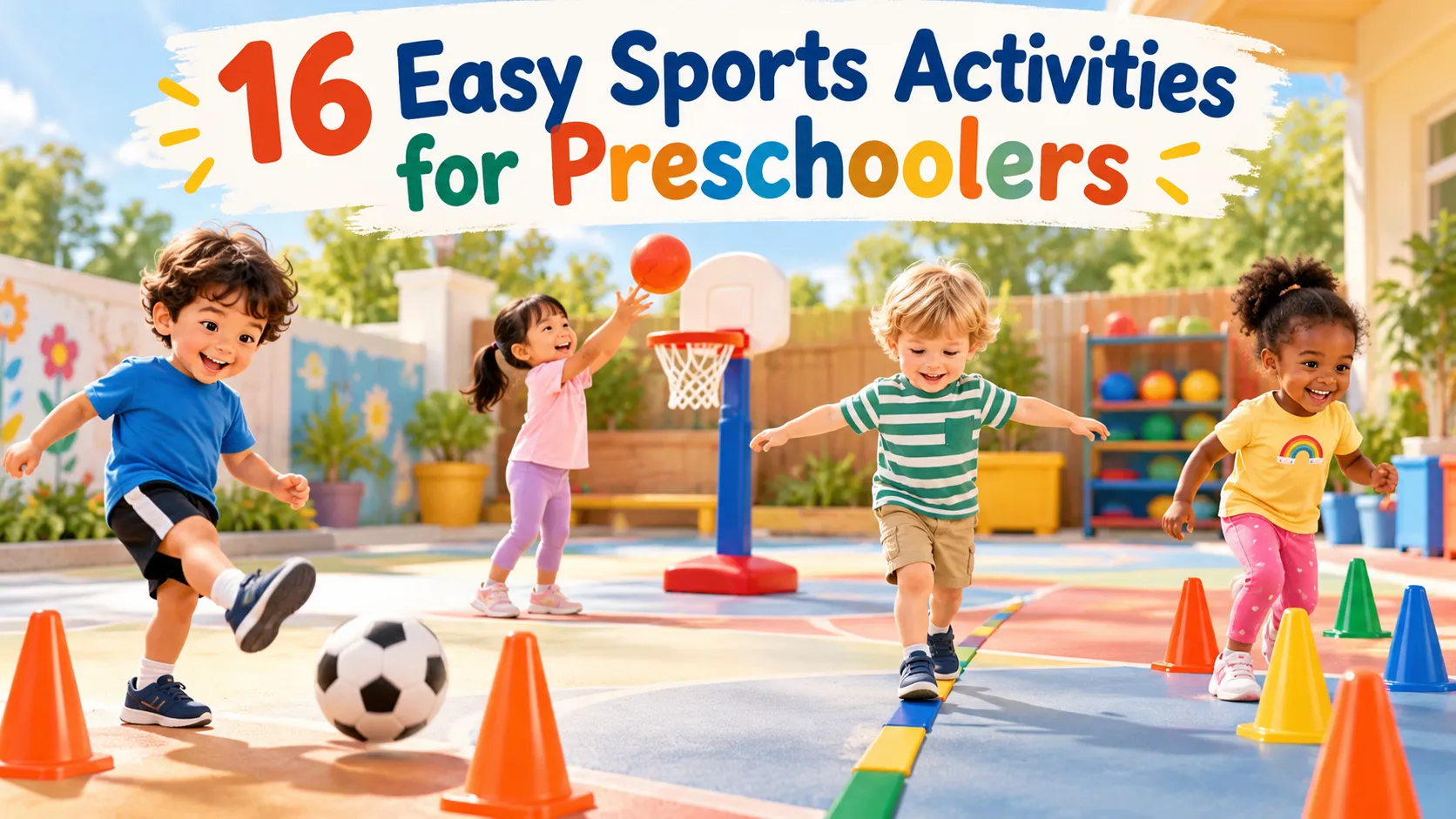
Sports activities for preschoolers don’t need elaborate equipment, complicated rules, or a full-size playing field. A few soft balls, floor markers, and everyday household items are enough to introduce children to kicking, throwing, jumping, and balancing through play.
For children ages 3–5, the experience matters more than the score. A wide soccer goal is often more inviting than a competitive match, while rolling a ball into a basket can be just as engaging as shooting hoops.
The 16 activities below include ball games, movement challenges, indoor options, and cooperative games. Each can be adjusted for different abilities, group sizes, and available spaces.
How to Choose Preschool Sports Activities
The easiest games to organize usually have one clear objective. Kick the ball between two cones. Walk along a line. Knock over the bowling pins. Children can understand what they’re trying to do without remembering several rules at once.
Before choosing an activity, consider the space, equipment, and children participating.
A useful starting checklist includes:
- Space: Leave enough room for movement without children colliding with furniture or one another.
- Equipment: Choose lightweight, age-appropriate items that children can comfortably handle.
- Difficulty: Begin with large targets and short distances before adding challenges.
- Group size: Decide whether everyone can participate simultaneously or whether smaller groups would work better.
- Flexibility: Allow walking instead of running, rolling instead of throwing, or other suitable adjustments.
For preschoolers, sports are best introduced as playful movement rather than a miniature version of organized competition.
The CDC recommends that children ages 3–5 stay physically active throughout the day through a variety of enjoyable activities. A short sports session can be one part of that daily play, alongside playground time and other opportunities to move.
Easy Ball Games for Preschoolers
Ball games introduce movements found in soccer, basketball, bowling, volleyball, and baseball without requiring children to learn formal sports rules.
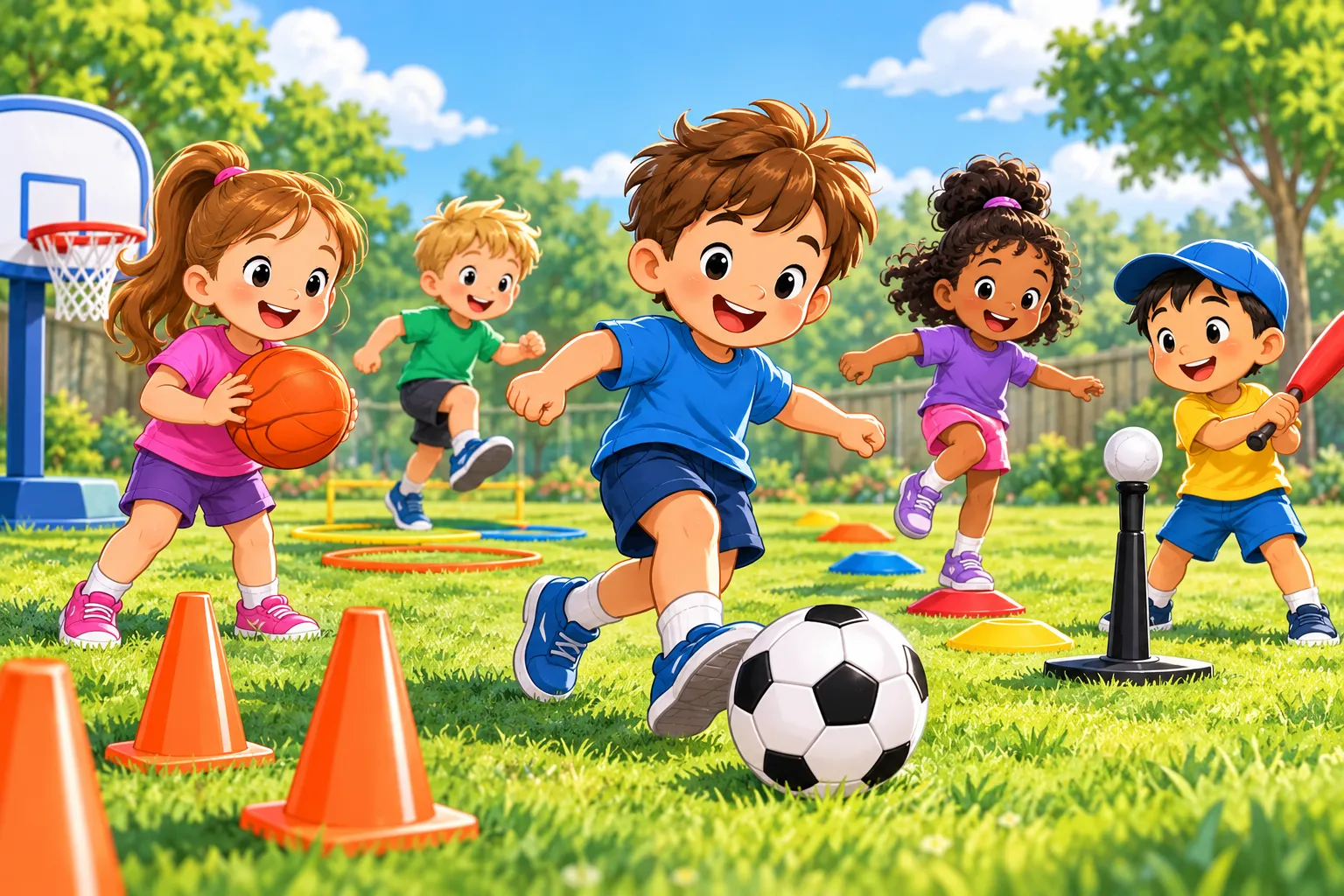
These five activities work particularly well when the goal is to explore what happens when a ball is kicked, rolled, tossed, or struck.
1. Mini Soccer Goal Challenge
Equipment: A soft soccer ball and two cones.
Set the cones several feet apart to create a wide goal. Place the ball a short distance away and invite children to kick it through the opening.
Start with a stationary ball. Once children feel comfortable, they can walk toward it before kicking.
For a different challenge, move the starting marker slightly to one side. The ball now needs to travel at an angle rather than straight ahead.
Younger participants can stand closer, while children ready for something harder can try a longer approach.
There’s no need for a goalkeeper or a running score. The excitement of sending the ball through the goal is enough to keep the game going.
2. Basketball Target Toss
Equipment: A large, stable basket and several soft balls.
Place the basket on the ground rather than using a regulation-height basketball hoop. Children stand nearby and attempt to toss the balls inside.
An underhand toss is a good starting point. Some children may prefer using both hands, particularly with a larger ball.
Once the activity feels familiar, introduce different throwing positions. Participants might try standing behind a floor marker or aiming from slightly farther away.
Avoid making the basket too difficult to reach. A larger target keeps the activity accessible without requiring children to throw harder.
3. Rolling Bowling
Equipment: Lightweight bowling pins or empty plastic bottles and a soft ball.
Arrange the pins at one end of a clear floor or patio area. Children take turns rolling the ball toward them.
After each attempt, invite a child to help stand the pins upright again. Resetting the game becomes another part of the activity rather than something everyone must wait through.
Try arranging the pins in a straight line instead of a triangle. Children can experiment with aiming for the middle or targeting one side.
If the ball repeatedly misses, shorten the distance before changing anything else.
This game also works indoors because the ball can remain on the floor throughout the activity.
4. Soft-Ball Volleyball
Equipment: One large, lightweight foam ball and a floor marker.
Traditional volleyball rules are unnecessary here. Mark a dividing line on the floor and ask children to gently toss or tap the ball toward someone on the opposite side.
Catching is allowed. So is letting the ball bounce before returning it.
An adult can join beginners and return the ball slowly, giving children more time to react.
For a cooperative variation, challenge the group to move the ball across the line several times without worrying about which side scores.
Keep enough distance between participants that they aren’t reaching into one another’s space.
5. T-Ball Target Practice
Equipment: A preschool-appropriate foam bat, soft ball, stable tee, and an open hitting area.
Place the ball on the tee and demonstrate a gentle swing. One child enters the hitting area at a time while an adult supervises.
Keep other participants well outside the bat’s swing radius and the direction of the hit. Nobody should retrieve the ball until the bat has been put down.
Instead of measuring distance, mark a broad target area where the ball can travel.
For children who aren’t ready to handle a bat, use the same target with a rolling or underhand tossing activity.
T-ball is best treated as a closely supervised station, not a free-for-all game with several children swinging simultaneously.
Running, Jumping, and Balance Games
A few cones and floor markers can turn an open space into a movement course. These activities give children different ways to travel, change direction, and explore balance without needing a ball.
6. Cone Path Challenge
Equipment: Four to six soft cones.
Arrange the cones in a gentle zigzag pattern, leaving comfortable gaps between them.
Demonstrate how to move around each cone without knocking it over. Children can begin by walking the route, then try a light jog when space and ability allow.
To make the path more interesting, introduce a stop sign at the last marker or ask children to take giant steps between two cones.
For larger groups, start participants at intervals so nobody feels pressured to rush through the course.
7. Jump the River
Equipment: Painter’s tape or flat, nonslip ground markers.
Place two parallel lines on a level surface to represent a pretend river.
Children try to cross without landing between the lines. They can jump with both feet or take one large step, depending on what feels comfortable.
Begin with a narrow gap. Rather than continuously widening it, offer different river widths and let children choose their challenge.
An imaginative twist is to pretend the river leads to an island. Children cross, turn around, and return to the starting shore.
Keep all jumps at ground level, away from elevated platforms or hard obstacles.
8. Balance Line Walk
Equipment: Painter’s tape or a flat balance marker.
Make a straight line on the floor. Ask children to follow it from one end to the other at their own pace.
The first challenge is simply to stay near the line. Later, add a gentle curve or a point where participants stop and turn.
A child who finds the narrow line difficult can use a wider path made from two parallel strips of tape.
For extra variety, invite children to carry a small soft object while walking, provided they can do so comfortably.
An elevated balance beam isn’t necessary. A floor-level route keeps the setup simple and removes the need to climb.
9. Mini Obstacle Course
Equipment: Cones, flat hoops, floor markers, and soft beanbags.
Create a short route combining several familiar movements.
For example, children might:
- Walk around two cones.
- Step into a flat hoop.
- Follow a curved floor line.
- Toss a beanbag into a basket.
- Return to the starting point.
Demonstrate the entire route before inviting children to try it.
Keep the course low to the ground and avoid unstable furniture or obstacles that could tip over. If children struggle to remember the sequence, remove a station rather than repeatedly correcting them.
Once everyone understands the route, let the group suggest one safe change.
10. Animal Movement Relay
Equipment: Two markers and an open movement area.
Choose an animal and demonstrate a movement inspired by it. Children might waddle like penguins, take large elephant steps, or make small bunny hops.
Place a marker a short distance away and invite participants to travel toward it using their chosen movement.
Unlike a traditional relay race, this version doesn’t need a fastest team. Children can complete the route together or take turns demonstrating different animals.
Someone who prefers not to jump can choose a walking movement instead.
The animal theme makes a simple movement exercise more imaginative without adding difficult instructions.
Indoor Sports Games for Rainy Days
Bad weather doesn’t have to cancel active play. The main adjustment indoors is controlling how far and how quickly children move.
Clear an open area, remove obstacles, and choose games that emphasize aiming, rolling, and careful stepping rather than running.
11. Sock Ball Target Throw
Equipment: Soft fabric balls or securely rolled socks and a wide basket.
Place the basket on the floor and mark a nearby throwing position.
Children toss the soft objects toward the opening. A close target is useful for beginners, while a second, slightly more distant target provides an optional challenge.
Try giving the baskets different names, such as the near goal and far goal, rather than assigning winners.
Check that homemade fabric balls have no loose components or small objects inside.
12. Indoor Goal Roll
Equipment: A soft ball and two floor markers.
Create a small goal against an open section of wall, leaving space so the ball can stop safely.
Children sit or kneel behind a starting marker and roll the ball toward the opening.
A partner can collect it and roll it back, turning the activity into a gentle passing game.
Unlike indoor soccer, this version doesn’t require kicking or chasing the ball across the room.
Keep the playing surface clear and discourage sliding or diving to stop a shot.
13. Floor Marker Challenge
Equipment: Large, flat, nonslip colored markers.
Spread several markers across a clear floor, with enough space to step between them.
Call out a color and invite children to move toward the matching marker. Begin with walking, then introduce sideways steps or simple turns.
For a small group, the leader can demonstrate an action instead of naming a color.
Older or more experienced preschoolers may enjoy combining two instructions, such as moving to a blue marker and turning around.
When space is limited, children can stay in one spot and touch nearby markers with their feet rather than traveling across the room.
Cooperative Sports Activities
Some preschoolers enjoy working toward a shared goal more than competing for points. Cooperative games also make it easier to adjust the challenge without separating children into winners and losers.
14. Partner Ball Pass
Equipment: One large soft ball for each pair.
Partners face each other and gently roll the ball back and forth.
Begin close together. As they become comfortable, move the starting positions slightly farther apart.
When both children are ready, introduce a gentle two-handed toss. Returning to rolling is always an option.
To vary the game, partners can try sending the ball through a pair of cones placed between them.
Avoid turning the activity into a contest over which pair completes the most passes.
15. Team Target Challenge
Equipment: Soft beanbags, a large basket, and a starting marker.
Instead of counting individual points, give the entire group one shared target.
For example, everyone works together to land several beanbags inside the basket.
Children take turns contributing. Some may throw from behind the starting line, while others use a closer position or roll a soft object toward a floor target.
When the group reaches its goal, celebrate the collective effort and offer another round if children remain interested.
The number of successful attempts is simply part of the game, not a measure of anyone’s ability.
16. Follow-the-Leader Sports Circuit
Equipment: Cones, soft balls, and floor markers.
Arrange three small stations representing familiar sports movements.
At the first station, children pretend to shoot a basketball. At the second, they gently kick a ball through a wide goal. At the third, they follow a short cone path.
Choose a leader to demonstrate the movement at each station.
Rotate the leader role so different children can suggest actions. An adult can offer simpler alternatives when necessary.
This is a useful way to revisit favorite games without introducing a completely new set of rules.
Adapt Games for Ages 3, 4, and 5
A target-toss game can work for a three-year-old and a five-year-old without requiring separate equipment. Often, changing the distance or number of instructions is enough.
Use the following examples as flexible starting points rather than fixed developmental expectations.
| Age | Example adaptation | Activity focus |
|---|---|---|
| 3 years | Large targets, close distances, one movement at a time | Exploring basic actions |
| 4 years | Moderate distances and simple combinations | Practicing movement control |
| 5 years | Short sequences and cooperative tasks | Connecting movements and following shared rules |
Children don’t acquire skills on an identical schedule. A confident three-year-old might enjoy a longer throwing distance, while an older beginner may be happier starting close to the target.
For mixed-age groups, keep the basic activity the same and provide choices.
With soccer, for example, everyone aims at the same goal but chooses a comfortable starting point. In a jumping game, participants may step across the pretend river instead.
These adjustments allow children to join the same experience without requiring identical performances.
A Simple Preschool Sports Session
With 16 activities available, there’s no reason to introduce all of them in one session. A smaller selection gives children time to explore each game without constant transitions.
Here’s one possible sequence for home, preschool, or a small group event:
- Begin with animal movements. Use Animal Movement Relay to introduce playful movement and help children become familiar with the space.
- Move to a ball challenge. Set up Mini Soccer Goal Challenge with a wide opening and comfortable kicking distances.
- Change the movement pattern. Introduce Balance Line Walk or a short obstacle course.
- Try a cooperative game. Bring children together for Partner Ball Pass or Team Target Challenge.
- Finish at a calmer pace. Walk together, collect equipment, offer water, and take a rest break.
This sequence is an example, not a prescribed exercise schedule. Adjust its length to the group, available space, and children’s responses.
If a station attracts too many participants, create another target or divide the group into smaller groups. When interest fades, switch activities rather than insisting everyone finish a predetermined number of rounds.
For larger school events, several of these games can become stations within a program of field day activities for kids.
Keep Sports Play Safe and Inclusive
Adult supervision is essential during preschool sports, especially when children are handling equipment or moving through shared spaces.
Inspect the activity area before starting. Remove tripping hazards, keep throwing zones separate from walking routes, and choose lightweight equipment designed for young children.
A few practical rules make activities easier to manage:
- Keep children outside the swing area whenever a bat or similar implement is used.
- Use stable, low targets instead of equipment that requires climbing.
- Allow enough space between children during running and throwing games.
- Provide drinking water and regular opportunities to rest.
- Adjust outdoor play for heat, weather, and the condition of the ground.
- Stop an activity when a child experiences pain, dizziness, or unusual distress.
In hot weather, move strenuous games to a cooler time or shaded area and watch for signs of overheating. A child who appears faint, confused, or seriously unwell needs immediate attention, and suspected heatstroke requires emergency medical care.
Inclusive participation is equally important. A child with limited mobility might enjoy seated ball passing, a closer target, or a modified movement station. Adapt the activity to individual abilities and relevant guidance from caregivers or professionals.
Avoid turning missed targets into failures. Children can try a different approach, take a break, or choose another activity without being singled out.
Keep the Fun Going After Play
Once the cones and balls are put away, a quieter creative activity can provide a natural transition.
Children who enjoyed soccer may want to draw a goal or color a football scene. Others might recognize a basketball hoop, bowling pins, or a baseball bat from the games they played.
Explore sports coloring pages for preschoolers and invite children to choose a familiar sport.
The next session doesn’t need an entirely new collection of games. Returning to a favorite activity with one small change can give children another enjoyable opportunity to play.